
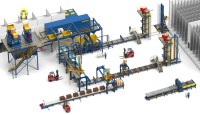
 Es un trabajo de largo recorrido desde las materias primas, pasando por la mezcla hasta al bloque de hormigón final. En este proceso participan muchos componentes. Solo si se coordinan las partes de la instalación, se garantizará un proceso sin problemas y buen rendimiento económico de la equipo de fabricación de prefabricados de hormigón.
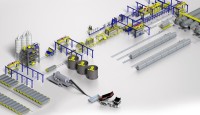 La fabricación de hormigón celular autoclavado impone altas exigencias en el tratamiento y dosificación de la materia prima, la supervisión del proceso de fraguado y el control de todas las fases de fabricación. Las instalaciones de fabricación de hormigón celular autoclavado de Masa se han perfeccionado a nivel técnico y se han concebido según las exigencias individuales de nuestros clientes. De esa forma son soluciones completas, que garantizan operaciones de procesos optimizados y muy económicos con una calidad constante del producto final.
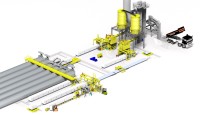 Es un trabajo de largo recorrido desde las materias primas, pasando por la mezcla hasta la piedra final. En este proceso participan muchos componentes. Es necesario que las partes de la planta estén armonizadas entre sí para garantizar un funcionamiento sin contratiempos y rentable de la de planta de producción de ladrillo de arena y cal.
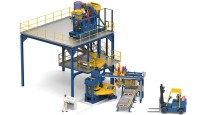 El camino que va de la materia prima, pasando por la mezcla, hasta llegar al bloque (o bordillo) final es largo. Las prensas de bordillos Masa han sido desarrolladas para cumplir, entre otros, los requisitos especiales de «British Standard» para los bordillos. Esta norma «British Standard» se aplica aún hoy en el Reino Unido y en ciertos países de Oriente Medio.
 Las instalaciones y maquinaria de Masa se instalan y se ponen en marcha por parte de nuestros propios y experimentados montadores. De esta forma, Masa apuesta por personal especializado cualificado y formado en Alemania.
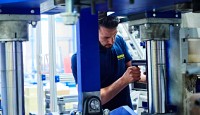 El servicio lifetime Masa va mucho más allá del montaje y la puesta en marcha de una instalación. Masa hace uso del conocimiento específico y la experiencia industrial de más de 110 años de servicio.
 ¿Necesita ayuda con su máquina? El Servicio Técnico de Masa destaca tanto por la calidad como por su accesibilidad notablemente mejorada. Ya se trate de "primeros auxilios" en el caso de problemas técnicos, actualizaciones, ampliaciones de funciones o consultas técnicas, el conocimiento del que disponemos en el marco del Servicio Técnico de Masa cubre una amplia gama de prestaciones.
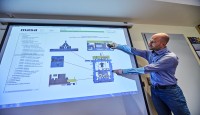 Una de las claves para el aumento tanto de la calidad como de la productividad es la formación continua de los operarios de la maquinaria y del personal de mantenimiento.
 ¿Busca un interlocutor o un contacto? Le presentamos al Equipo de Servicio de Masa.
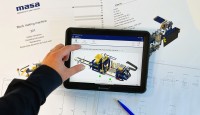 Masa Service Cloud es la última incorporación a la familia de productos digitales.
Focus on energy efficiency
Servo-hydraulics in the sand-lime brick pressPorta Westfalica 27 nov 2026 - Energy efficiency remains a key issue in sand-lime brick production. Comparative measurements and practical experience demonstrate the potential offered by the Masa HDP 1200 Jumbo servo-hydraulic press for an energy-efficient pressing process. Furthermore, there are additional benefits for production operations.
Energy efficiency through modern drive concepts
Due to the process itself, the pressing operation for compacting the sand-lime brick mix is one of the energy consumers in the production of sand-lime bricks. In a conventional hydraulic press with swivel pump technology, the electric motor runs at a constant speed. Pressure, flow rate and direction are controlled via valves. If the hydraulic power supplied is not fully utilised, excess hydraulic oil flows back into the tank – resulting in energy loss. Optimising the drive concept therefore offers considerable potential for energy savings.
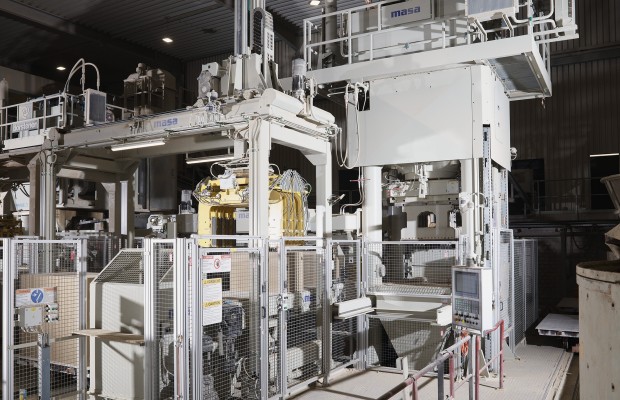
This is precisely where Masa WhiteHUB comes in with the servo-hydraulic sand-lime brick press HDP 1200 Jumbo. This type of press has been available for several years and is being used successfully in industrial applications [1]. Internal comparative measurements and practical experience from production operations show that the servo-hydraulic drive concept can both reduce energy consumption and increase productivity [2].
Servo-hydraulics as an alternative to conventional hydraulics
The use of servo-hydraulics consistently pursues the aim of adapting the power supplied to actual requirements. To this end, a speed-controlled electric motor regulates the speed of the drive, thereby enabling direct control of flow rate and pressure and, ultimately, of the force and speed of the press. The variable-speed control of the hydraulic pumps thus adapts the power consumption to the current process requirements [1].
In contrast to conventional hydraulic systems, the required hydraulic power is not primarily regulated via valves, but is provided directly via the speed of the drive motors. As a result, the hydraulic pumps deliver only the volume of oil actually required for the respective process step. In particular, during dwell times or during movements with low power requirements, the power consumption of the drive system falls significantly. This reduces losses in the hydraulic system and improves the overall efficiency of the press.
Internal comparative measurements and practical experience from production operations demonstrate significant potential for reducing energy consumption. Furthermore, the simplified hydraulic structure results in greater press dynamics, lower noise levels and reduced maintenance requirements.
Experience to date shows that the benefits are particularly noticeable in the manufacture of large-format sand-lime brick products. The advantage is most evident in products with longer pressing and holding times. Whilst in conventional hydraulic systems the drive motors continuously consume energy even during these phases, the servo-hydraulic system can reduce its power consumption to match actual requirements.
Comparative measurements of the drive concepts
To assess the energy-saving potential, internal comparative measurements were carried out at Masa on an HDP 1200 Jumbo with servo-hydraulics and an HDP 1200 Jumbo with a conventional hydraulic drive [2].
The difference in energy consumption relative to the volume produced was particularly striking. Energy consumption was significantly lower than that of the conventional version [2].
The results confirm the technical approach of demand-based power delivery. Thanks to the variable-speed control of the hydraulic pumps, only the power actually required in each process step is supplied.
Practical experience from production operations
The results of the comparative measurements are confirmed by operational data from a European sand-lime brick plant. For this purpose, two HDP 1200 Jumbo presses with different drive concepts were evaluated. One press was equipped with servo-hydraulics, the second with a conventional swivel-pump hydraulic system [3].
The analysis shows a reduction in specific energy consumption from 3.450 kWh/t to 2.541 kWh/t. This corresponds to a saving of around 26 per cent based on the assessed tonne output [3].
In terms of standard-format output, there was also a significant improvement. Energy consumption fell from 12.93 kWh/NF to 9.24 kWh/NF. This corresponds to a reduction of around 29 per cent [3].
Furthermore, at 37.76 kWh/h, energy consumption per operating hour was considerably lower than the comparative figure for the press with conventional swivel-pump hydraulics, which was 57.26 kWh/h. This corresponds to a reduction of around 34 per cent [3].
When evaluating the results, it should be borne in mind that the presses examined were manufactured in different years [3]. The analysis serves primarily as a practical example under real production conditions and confirms the general trend observed in the comparative measurements presented earlier.
The analysis is based on real production data and takes into account both energy consumption and the actual plant output achieved during the study period.
The results highlight the potential of modern servo-hydraulics to reduce energy consumption in the pressing process.
Advantages in the manufacture of large-format products
The HDP 1200 Jumbo from Masa WhiteHUB was developed for the cost-effective manufacture of large-format calcium silicate brick products. Products with brick heights of up to 675 mm can be produced with a uniform bulk density across the entire product height.
The advantages of servo-hydraulics are particularly evident with large-format products. By adapting the hydraulic power to the specific process requirements, energy consumption can be significantly reduced compared with conventional hydraulics. In addition to energy efficiency, the higher dynamics of the press are another advantage of this drive concept.
Furthermore, the press is equipped with various functions to stabilise the production process. These include, amongst other things, a pre-stressed frame system to minimise deformation during compaction, as well as automatic correction of the expansion rate through additional brick height measurement.
Lower noise emissions
In addition to the energy-related benefits, lower noise levels are also observed. As the hydraulic pumps are not operated continuously at a constant speed, noise pollution in the vicinity of the press is reduced [1].
Simplification of the hydraulic system
The use of servo technology allows the number of mechanical components to be reduced by around a third compared with a comparable conventional design. The speed-controlled operation of the hydraulic pumps enables more precise adjustment of pressure and flow rate to the respective process conditions. This means that some of the valve technology required in conventional hydraulic systems can be dispensed with.
The lower throttling losses reduce the heating of the hydraulic oil, which in turn can reduce the cooling requirements. At the same time, the lower thermal load has a positive effect on the ageing of the hydraulic oil. This simplifies the design of the press and contributes to a maintenance-friendly plant structure.
Conclusion
Servo-motor-driven hydraulic pumps can make a significant contribution to increasing the energy efficiency of sand-lime brick presses. Internal comparative measurements and evaluations from production operations show that servo-hydraulic drive concepts can both reduce energy consumption and increase productivity.
Servo-hydraulics operate on the principle of on-demand energy supply. Instead of a permanently available maximum power output, the drive power is supplied only to the extent actually required by the respective process step. This reduces energy losses in hydraulic systems and enables presses to be operated more efficiently. In addition to energy savings, further benefits include improved dynamics, lower noise emissions and a simplified hydraulic design.
Sources
[1] AAC worldwide, Issue 01/2020: “Servo motors optimise sand-lime brick presses”. Technical article on the application of servo-motor-driven hydraulic systems in sand-lime brick presses.
[2] Internal comparative measurements on HDP 1200 J presses with servo-hydraulics and conventional hydraulic drives, analysed using Masa WhiteHUB.
[3] Operational measurements on two HDP 1200 Jumbo presses with different drive concepts at a European sand-lime brick plant, analysed using Masa WhiteHUB.